Monday, October 4, 2010

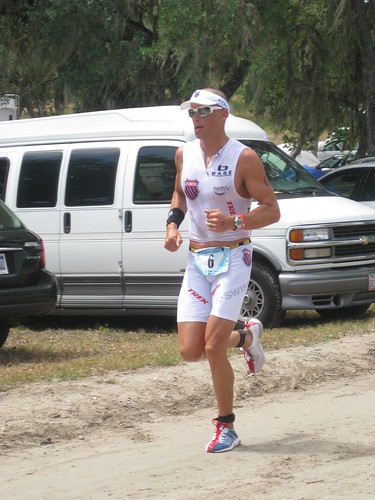
Chris Lieto's Secret Weapon?

The countdown to the biggest dance of the year--if you're a triathlete and not a Dancing With the Stars fan, that is--is on in full force. That's right, the Ironman World Championship in Kailua-Kona, the race that many triathletes dream of racing and only a few are so lucky to attend, takes place on Saturday, October 9, and the competitors have been spilling onto the Big Island. By this time next week people will be boarding--or being rolled onto, depending on the state of their legs after 140.6 miles--planes for the mainland, packing their bikes and bags, and readying for much-needed time off.

But before that happens, the 2010 Ironman World Champion has to be decided. Will Craig Alexander earn the three-peat? Will a previous winner like Faris Al-Sultan, Normann Stadler or Chris McCormack take the crown? Or will it be a new name like 2009 runner-up Chris Lieto, who possibly represents the U.S.'s best chance at a win? And when I read that two elite runners were packing their bags for the Big Island to cheer on Lieto, it got me wondering about his race-day potential and what he'd be bringing to the table. When you pore over race results for work, follow one-too-many athletes and have watched the 2009 Ironman show down an unhealthy amount of times, you start to assemble a list of what-ifs. Or at least I did.

Lieto is a monster on the bike. If you've watched the World Championship in the last few years, you've probably noticed that Lieto moves to the front of the pack on the bike--he came into T2 first last year and was the one to beat heading into the run. Alexander, a strong runner, did just that--he ran Lieto down, slowly chipping away at his lead and eventually striding by. Alexander can hold his own on the bike, but you most like won't find him leading like Lieto. But the tables are turned on the run where you could almost view the marathon as Lieto's weakness. Yikes, I'm not trying to sound as if I know everything about this triathlete and I can't even say how accurate this assessment is, but I'm starting to think that Lieto could pose an even greater challenge to Alexander this year--or maybe win it all.

Why? Because I'm guessing that he might have some secret weapons in his training arsenal: Ryan Hall and Josh Cox, the two runners heading to Kona to cheer him on. Hall's out of running Chicago, but he'll be in Kona before heading to the Windy City to support his Hall Steps Foundation runners. And after Hall leaves, Cox arrives to watch the Big Dance. The Hawaii trips don't exactly provide the evidence I was looking for, but these considerations did:
  • It's known that Lieto has been working on his run more. Craig Alexander says he noticed it when he raced Lieto in two 70.3 races last year in preparation for Kona. Crowie beat Lieto in both races, but not by much, and admitted that Lieto not only looked stronger on the run but he also was faster.
  • That statement alone makes me think that the threesome of Lieto, Cox and Hall has been working together up in Mammoth. Hall and Cox live and train in Mammoth Lakes along with other elite runners like Meb Keflezighi and Deena Kastor. Lieto's a born and bred Californian, and it's been reported that he trains in Mammoth. Sure, he could be there for higher-altitude cycling, but it almost makes too much sense for him to run, too.
  • Why wouldn't he employ the help of two elite runners for tips on faster running and some fast legs to follow on a training run? Especially when one of those runners is a K-Swiss teammate? That's my theory anyway.
  • Bobby McGee, a running coach (maybe professor is a better word since he knows so much about the sport, getting faster and biomechanics), said that a triathlete can lose a race because of the run and can win a race with a good run. Not his exact words--he said it better than my rough summary--but those words stuck in my head. Work too hard on the bike and your legs develop muscles that can actually inhibit your running. Sounds a little like Lieto has super-developed cycling legs, a cycling triathlete, that often fail him on the run--only because a runner triathlete can outrun him when it counts.
  • If Hall and Cox are heading to Kona to cheer for Lieto, wouldn't it make sense for them to provide him with some of their running expertise and go for a few taper runs? Or perhaps Lieto has been the guest runner on training days with Josh, Ryan and maybe even Meb. Or sharing the training and running advice from Josh and Ryan's coach Terence Mahon. Just hypothesizing.
The Kona travels just got me thinking that maybe 2010 would be the year Lieto became the groom and not the groomsman or usher. He came so close last year with a second-place finish. In a competition so tight, you know that one simple mistake or a slight falter could cost someone else the World Champion title. What do you think? Who's going to take it all at the Ironman World Championship this year? I can't wait to find out. 


Photo grabbed from thomas pix at flickr.

Sunday, October 3, 2010

Twin Cities vs. Chicago, Who Wins?

If you were looking to run the Bank of America Chicago Marathon but couldn't sign up in time (the race closed less than 55 days after it opened on Feb. 1, 2010), chances are you found another Midwest race to meet those fall marathon goals. Two such races--Twin Cities in Minneapolis and St. Paul, Minn., and Lakefront in Milwaukee, Wis.--near and somewhat dear to my heart took place this weekend and offer some of the same charm as the Windy City's race but also enough variation for anyone who decided long ago that Chicago wasn't the place to run a marathon. And being that I become rather obsessed with races, results and marathons this time of year (oh and the Ironman World Championships), I had to give a shout-out to my husband's hometown and the spot where he might be working next year.

While you'll have to wait 'til next year to run these two races, that doesn't mean you can't learn a little more about them almost a year in advance. In fact, it might actually help solidify monumental marathon decisions: where to run, when to run, should you run. So we're taking a look at some of the reasons to run these other two Midwest races that have found spots in the hearts of the Chicago running community. But first up, the Twin Cities Marathon (the two races needed their own posts).
  • This race has been held either the weekend before or the same day as Chicago, and both scenarios can work in the favor of Chicago runners. You can still train with your friends, just race in a different state. And you could end up with better weather.
  • If you take a look at weather.com's forecast for next Sunday and then the real-time temps for today, you might wish you're running 26.2 now instead of next week (depending on your ideal running temperature). And being that you're north of the Windy City in Minnesota, you're also more than likely to find chillier temperatures what you'll find close to home or could avoid a weather front that's heading toward Chicago.
  • Smaller scale. Not into running with 45,000 of your "closest" friends? This race was capped at 11,200 runners. While the spots were gone by early June, that's still more registration time than Chicago had this year.
  • Scenic. You'll run a tour of the two cities starting at the Metrodome and finishing at St. Paul's Capitol Building. It may not be an out-and-back or a traditional point-to-point (Boston, California International) but consider it a better option since you're not shuttled 26 miles to the race start.
  • Get the family and friends involved. You want to run a marathon. Your support team and/or friends want to participate too, but not for 26.2 miles. Twin Cities offers a weekend of running with the marathon and a 10-miler held on Sunday and a 10K, 5K and family events on Saturday.
  • If you're into running races when the race itself is celebrating a milestone, then this is definitely one to consider for 2011. The Twin Cities Marathon will celebrate its 30th running next October.
  • Flat and rolling course characteristics help produce Boston-qualifying times for several runners. And fast times for the elites too--Deb Buzunesh, a 23-year-old from Tampa, just topped the female results with a 2:27:24.
  • And for the elite American runners, it's a chance at a payday. Chicago, Boston and New York will have the fast feet from Kenya, Ethiopia, Russia and more, who will eventually go on to top the results lists. In Minnesota--if 2010's men's race is any indication--it's all about the American runners, or at least those who reside in the states. Deba Buzunesh, a 23-year-old Ethiopian from Tampa, Fla., won for the women, while Sergio Reyes, a 28-year-old from Palmdale, Calif., topped the men's results with a 2:14:02.
Have you run the Twin Cities Marathon? What did you like or not like about it?

Photo grabbed from meetminneapolis at Flickr.

Saturday, October 2, 2010

Fit-Pic: You Know You're in Kona When...


...you see some of the best Ironman athletes running the Big Island's roadways. Tanned, ripped, HRM-wearing eye candy--for the girls maybe and pangs of envy for the guys? Chris McCormack, a.k.a. Macca, shared this pic via Facebook from a run along the back section of the Ironman World Championships marathon course. Among the bunch you'll find McCormack, Terenzo Bozzone, Torsten Abel, Dirk Bockel and Rasmus Henning, all professionals set to race in Kona and usurp Craig Alexander. Now just wait for the underwear run later in the week where onlookers might seriously regret their day-before consumption or excuse for skipping their workout. That's even more intense eye candy.


Photo grabbed from Macca via Facebook.

Friday, October 1, 2010

Even the Best Runners Get Tired

Hopefully you're still not shell-shocked over Ryan Hall's announcement to drop out of October 10's Bank of American Chicago Marathon. On Tuesday, Hall cited fatigue as his reasoning for pulling out of the race where he hoped to break the American record. But while some sounded angry over Hall's decision, or disappointed that they'd no longer be sharing the course with the fast American and potentially sharing in his record-setting appearance, his justification simply makes sense. And can show us that even the best runners aren't superhuman--all the time.

Take Hall's blog posts at competitor.com. You could read his most recent entry, the one that followed the official announcement that he wouldn't be running, that essentially explains his take on the reasons behind dropping out. More political, more "hey fans, here's why I can't run in two weeks," more detailed. Deeper, if you will, provided I was asked to give a literary analysis on a blog post. Whether it's just good writing or good story-telling, Hall makes a compelling argument for postponing his next marathon until 2011. He didn't want to end up like Greg Meyer who told Hall not to make his mistake where he ran Chicago to defend his title, wasn't ready to run and he marks it as the beginning of the end for his running career. At 28, I'm sure Hall doesn't want to be done with his glory days--he has too many goals to yet accomplish.

And if you take a look at one of his older entries--or had followed all along from the beginning--it's really not surprising that he decided not to run. He's tired. No excuses about it. Just like any average runner hits the fatigue mark--after all, there is that saying that if you can survive marathon training, you can survive the marathon--so did Hall. And rather than push through it, he's a smart enough runner to know that as he ages, it becomes less and less possible to bounce back quickly from those tough sessions. He cited a 12-mile tempo run and a 25-mile long run within the course of three days. I know that's a lot for me to run--I'd be knocked up for at least a week after running 25 miles unless I walked most of it--and I'm sure it's still a lot for Hall, especially at the speeds he'd take those miles at. Or take a gander at Josh Cox's workouts, Hall's training partner up in Mammoth, which he posts regularly via Twitter and Facebook. How these guys don't get tired with double sessions, hours each, is beyond me. Sure, marathon runners can be deemed superhuman, but it's back to reality--and a little refreshing for the rest of us--when they show they need a break too.

Ryan, we'll miss you along the Chicago Marathon course, but will be looking for you supporting your Hall Steps Foundation runners and are happy you're still coming to the Windy City. And rest up so you can continue toward your American record goal. We're sure Hawaii will help with that much needed R&R--Hall and Cox will be there next week to support K-Swiss teammate Chris Lieto in his final preparations for the Ironman World Championships. 

Update: Liz just posted an awesome interview with Ryan Hall at Time Out Chicago. Check it out here.

A Quote to Remember

Ryan hall 2009"Sometimes when you're painting a masterpiece it gets messy. When I show up on the starting line in Chicago I want to make it special." --Ryan Hall, via Twitter

If Runner's World wants to add a quote to its Quote of the Day repertoire, I'm all for adding this one by Ryan Hall. Not because he's explaining his decision to not race the 2010 Chicago Marathon, but more because it's eloquent and one of those sayings that any runner might consider leading into race day. The eloquent aspect is rather obvious but the other bit may be more opinion than actual truth. But I like to think that it makes sense...maybe not for your first marathon if you're gung-ho on crossing the finish line no matter what, but most likely for that race where you wanted to run fast and now see you're going to fall short of your expectations--even those that others set upon you. 

In a somewhat weird way, I feel like I can identify with what Hall's saying. Or at least understand a bit more why he'd throw away--as some commented--the chance of leaping into the record books once again, having a huge payday, and not passing up any appearance fees. Sometimes it's just not your day. A simple phrase but one that not all of us runners always seem to understand.

Case in point: Chicago Marathon 2007. Yes, that one where it was 90-something degrees as the race crept on and was eventually canceled and turned into a fun run to salvage the racers still on course. I had already painted most of my masterpiece in training but the race would add the final touches--not the same as knowing while training that things were drastically wrong, but related enough where you hopefully catch my drift. Long story short, my clothes were soaked by mile 10 and I was really feeling the heat effects somewhere between miles 11 and 12. Before reaching the halfway mark--and the spot where I'd see my family--I already knew my race was over. No personal best, no decent time, no run all the way but slower. It was full-on survival mode--make it to the finish line to collect medal No. 8 and save my marathon legs for the potential of running a cooler race. As I stopped to walk, I'm getting pats on the back and encouraging phrases like "Hang in there!", "You'll be OK!", "You can do it!" Meanwhile, all I could help thinking was that I knew when to throw in the towel and call off the race. Fine I was still out there, unlike Hall who won't be toeing the line, but I'm at the point where my masterpiece got smeared and the only thing special about this race was finishing.

Second case in point: Chicago 2008. Hot again, but not as bad as the year before. Except this time I'm not only contesting the heat--where I know I struggle--but also coming off Ironman recovery. Good idea to run a marathon barely a month after a 140.6-mile race? Probably not. I could have used some of Hall's reasoning then to avoid the marathon altogether. Sure enough, I hit the wall at mile 15 and mustered the energy to walk/run the last 11 miles--I can't give up now--but I know that re-qualifying for Boston is not happening.

The key, or so I think, is that I lowered my expectations. It's what I can easily do as an age-grouper but probably doesn't come as easily for a professional. The only hype I have is my own and maybe my family's--they are nice enough to watch me year in and year out, no matter how slow or fast I go--and my finish time, and place, isn't riding on the hopes of millions. But I'll still have to pocket Hall's words for the times when I'm questioning why I'm showing up to race in the first place. When I don't want to run for fun, when I don't need a Boston-qualifying time, when it's too cold or hot to enjoy myself, or when I'm really too injured to battle through 26.2. In a weird way, I can learn something from Hall, even if others currently think he's a quitter. He's really just teaching us a lesson about when to listen to our bodies and how to make races special.

Photo by By George Roberts (Own work) [CC-BY-3.0 (www.creativecommons.org/licenses/by/3.0)], via Wikimedia Commons

LinkWithin

Related Posts Plugin for WordPress, Blogger...